
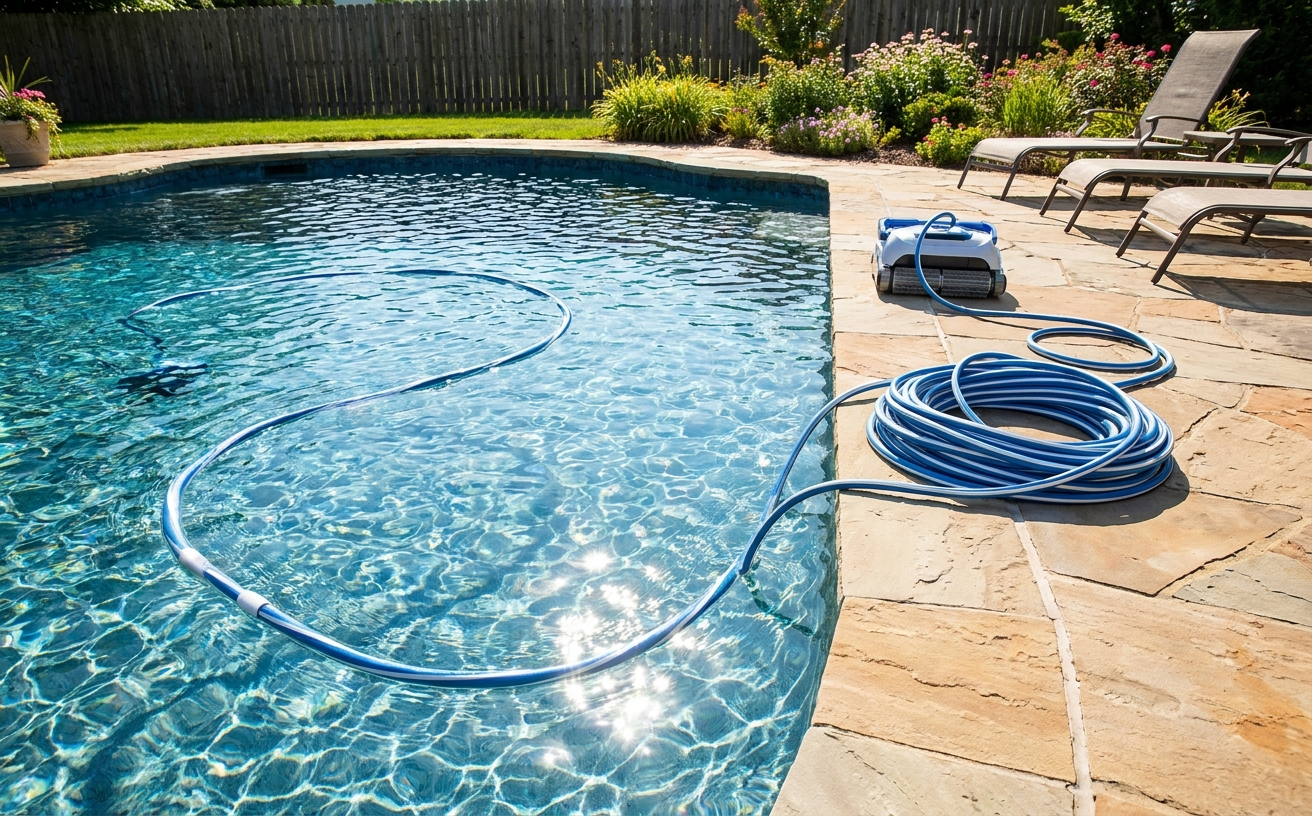
The cable is the least glamorous component of any pool cleaning system. It gets no marketing attention, no feature comparison, and no excited product review. But for owners who use their cleaner regularly, the cable becomes the single most frustrating part of the experience — or the single most invisible, depending on how well it is designed.
A tangled cable means ten minutes of untangling before every use. A cable that is too short means the cleaner cannot reach the far end of the pool. A cable that degrades means electrical faults that are expensive to repair. Understanding the cable before you buy prevents problems that no specification sheet will mention.
Why Cables Tangle
As the cleaner moves through the pool, the cable trails behind it on the water surface. Every turn the cleaner makes adds a twist to the cable. Over a two-hour cleaning cycle, the cleaner makes dozens of turns, and the cable accumulates dozens of twists. Without a mechanism to release these twists, the cable eventually coils into a tangled mess.
The solution is a swivel — a rotating joint built into the cable that allows it to unwind as twists accumulate. Cables with integrated swivels resist tangling effectively and require minimal management between cycles. Cables without swivels require the owner to manually uncoil the cable after every use, which adds five to ten minutes of frustrating work.
Not all swivels are equal. Some are positioned at the cleaner end of the cable, where they are submerged and subject to chemical and mechanical stress. Others are positioned at the power supply end, where they are dry and protected. Swivels at the power supply end last longer because they are not exposed to pool water.
Cable Length: Too Short Is Worse Than Too Long
A cable that is too short for the pool is not just inconvenient — it is functionally limiting. The cleaner will reach the end of its cable and stop, unable to clean the far portion of the pool. There is no workaround for a cable that is too short other than relocating the power supply closer to the pool, which may not be possible.
Measure the distance from the nearest electrical outlet to the farthest point in the pool, and add fifteen feet for slack and navigation. Compare this measurement to the cable length of any model you are considering. If the cable is shorter than your measurement, the model is not suitable for your pool.
Excess cable length is a minor inconvenience compared to insufficient length. A cable that is ten feet too long can be coiled at the power supply. A cable that is ten feet too short renders the cleaner partially useless. When in doubt, choose the longer cable.
Cable Floats and Water Surface Management
The cable floats on the water surface during operation. In an ideal world, the cable floats in a loose arc between the cleaner and the power supply, staying out of the cleaner’s path. In practice, the cable often drapes across the pool in a way that the cleaner’s navigation algorithm does not account for, leading to the cleaner wrapping around its own cable.
Some models include cable floats — small foam collars that attach to the cable at intervals and keep it elevated on the water surface. These floats reduce the likelihood of the cleaner entangling itself by keeping the cable spread across the surface rather than bunched in one area.
If your model does not include floats, aftermarket cable floats are available and inexpensive. Adding three to five floats along the cable’s length significantly reduces tangling and self-entanglement during operation.
Cable Degradation and Safety
The cable jacket is exposed to sunlight, pool chemicals, and physical abrasion from the pool deck. Over time, the jacket degrades — becoming stiff, cracked, or brittle. A cracked jacket exposes the internal conductors to water, which creates a short circuit and renders the cleaner inoperable.
Inspect the cable visually before each season. Look for cracks, cuts, or areas where the jacket has worn thin from dragging across the deck. Any damage to the jacket warrants cable replacement before the cleaner is used again, because water intrusion into a power cable is a safety hazard.
Cable replacement costs vary by model but typically range from fifty to one hundred fifty dollars. This is a routine maintenance cost for any robotic pool cleaner that is used regularly for three or more years. Budget for it as you would budget for brush and track replacement.
Storage Between Uses
How the cable is stored between uses affects its longevity. Coiling the cable tightly around the power supply creates stress points that accelerate jacket cracking. Draping it loosely over a hook or cable management system distributes the stress and extends the jacket’s life.
The ideal storage method is a wall-mounted cable hook or reel positioned near the power supply. The cable hangs in loose loops that do not create sharp bends or stress concentrations. This method takes slightly more wall space than tight coiling but adds years to the cable’s service life.
Never store the cable in direct sunlight. UV degradation is the primary cause of jacket failure. A cable stored in a shaded location or covered with a UV-resistant sleeve will last significantly longer than one left exposed on the pool deck.
The cable is not an afterthought. It is the component that connects the power to the machine, and its condition determines whether the cleaner operates reliably or sits idle waiting for a repair. Choose a model with a swivel, measure the length you need, add floats, inspect the jacket, and store it properly. The cable will reward the attention with years of tangle-free operation.
