
The transition from the structured classrooms of high school to the self-driven, often chaotic environment of a university is a steeper climb than most students anticipate. It isn’t just that the volume of work increases; it’s that the nature of the tasks becomes incredibly diverse. On any given Monday, you might find yourself switching gears from a deep-dive literary analysis of 19th-century prose to solving complex differential equations. This constant mental “context switching” is where many undergraduates lose their momentum, leading to late-night sessions fueled more by caffeine than by actual comprehension.
Success in modern higher education isn’t necessarily about working harder, but about working with a sense of strategy. When the pressure of competing deadlines starts to mount, it is perfectly normal to feel like you are spinning too many plates at once. In these moments of high stress, knowing when to delegate or seek professional resources that can help me with my assignment can be the difference between maintaining your GPA and facing total burnout. Strategic learning involves identifying which tasks require your absolute focus and which ones benefit from external guidance or structured templates. By treating your education like a project manager treats a corporate campaign, you can navigate the complexities of university life with far less friction.
The Anatomy of Task Variety in Higher Education
To master university life, you must first categorize your workload. Not all assignments are created equal, and applying the same study method to every module is a recipe for inefficiency. Generally, undergraduate tasks fall into three main buckets:
- Qualitative Synthesis: This includes essays, case studies, and reflective journals. These require a “narrative brain” that can connect disparate ideas and build a persuasive argument.
- Quantitative Analysis: Think problem sets, lab reports, and mathematical modeling. Here, precision and logic are the only metrics that matter.
- Technical Application: This covers coding, design projects, or clinical simulations. These demand hands-on skill and a “trial and error” mindset.
Understanding which “brain mode” you need to be in before you open your laptop can save you hours of unproductive staring at a blank screen. If you know you are in a “logic” mood, tackle your data sets. If you feel more creative, save that time for your literature review.
The Balancing Act: STEM vs. Humanities
For students pursuing dual degrees or those taking general education electives, the shift between STEM (Science, Technology, Engineering, and Math) and the Humanities is particularly grueling. Research suggests that “cognitive switching” carries a heavy time cost. If you spend four hours writing a history paper and then immediately try to solve physics problems, your brain is still partially stuck in “narrative mode,” making the logic-based physics problems feel much harder than they actually are.
To mitigate this, successful students use a “buffer zone.” This could be a thirty-minute walk, a gym session, or even a different physical study location. By associating specific desks or cafes with specific types of work, you prime your brain for the task at hand. However, despite the best preparations, some subjects remain inherently more difficult to grasp than others. If you find yourself stuck on a specific calculus proof or a statistics project that just won’t click, reaching out to MyAssignmenthelp to do my math homework can provide the clarity and step-by-step breakdown you need to actually learn the underlying concepts rather than just getting through the day.
High-Impact Study Strategies for Undergraduates
Mastering your tasks requires a toolkit of methods that go beyond highlighting textbooks. Highlighting is a passive activity; true mastery comes from active engagement. Here is a breakdown of how to approach different academic requirements for maximum impact:
| Task Type | Recommended Strategy | Expected Outcome |
| Long-form Essays | The Reverse Outline | Ensures logical flow and identifies gaps in your argument. |
| Math & Logic | Spaced Repetition | Builds “muscle memory” for complex formulas and theorems. |
| Exam Revision | Active Recall | Tests your ability to retrieve info without the help of notes. |
| Group Projects | The RACI Matrix | Clarifies who is responsible for which part to avoid conflict. |
The Power of “Information Gain” in Writing
When you are tackling your writing assignments, Google’s latest search standards and university professors both look for the same thing: Information Gain. In the academic world, this means you shouldn’t just repeat what is in the textbook or what was said in the lecture. You should bring a unique perspective, a new analogy, or a personal observation to the table.
If you are writing about economics, don’t just define inflation; explain how it affects the specific price of the coffee in your campus cafeteria or the rent in your local student housing. This level of specificity makes your work more engaging for a human reader and signals to graders that you have truly internalized the material rather than just being a generic summary machine.
Leveraging Professional Academic Resources
There is a persistent myth that asking for help is a sign of weakness or academic failure. In reality, the most successful people in any field—whether business, medicine, or academia—are those who know how to manage their resources efficiently. Professional support services exist to act as a bridge. They provide models of excellence that students can use to improve their own writing and problem-solving skills.
Using these resources ethically means using them as a roadmap. If you receive a modeled assignment, study how the arguments are structured, how the citations are formatted, and how the conclusion ties back to the introduction. This helps you build a mental library of what a “good” assignment looks like, ensuring that you are better prepared for your final exams and future career challenges.
The Digital Distraction Dilemma
In a globalized learning environment, the tools we use can either be our greatest assets or our biggest distractions. A student in London and a student in Sydney face the same challenge: the “infinite scroll.” To master diverse tasks, you must master your digital environment.
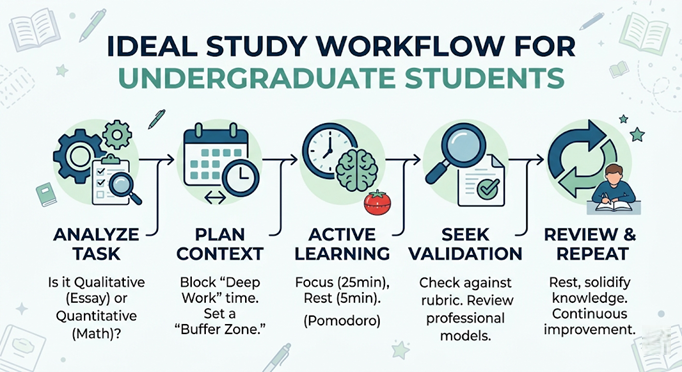
Use browser extensions to block social media during “Deep Work” sessions. Try the Pomodoro Technique (25 minutes of work followed by 5 minutes of rest) to keep your brain fresh. Most importantly, organize your digital files by subject and task type. Finding your research notes shouldn’t be a task in itself; keep your desktop clean so your mind can stay focused on the actual learning.
Creating a Sustainable Routine
Finally, academic mastery is about consistency, not intensity. A “heroic” twelve-hour study session once a week is far less effective than two hours of focused work every day. Build a routine that respects your natural energy levels.
If you are a morning person, tackle your most difficult math or science problems before lunch when your brain is sharpest. Leave the creative writing, lighter reading, or group meetings for the afternoon when your energy might dip. By aligning your tasks with your biological clock, you reduce the willpower needed to get things done.
FAQs
Q: How do I stop procrastinating on difficult math assignments?
A: The best way is to “chunk” the work. Instead of trying to finish the whole set, commit to solving just two problems. Often, the hardest part is starting. If the logic remains confusing, seeking a walkthrough from a specialist can help break the mental block and give you the momentum to continue.
Q: What is the best way to improve my essay grades quickly?
A: Focus on your “thesis statement.” Every single paragraph in your essay should serve to prove that one central argument. If a sentence doesn’t support your thesis, delete it. Clarity and conciseness always beat “fluff” or overly academic language.
Q: Is it okay to use online academic help services?
A: Yes, as long as you use them as a learning tool. Think of it as a personalized textbook or a private tutor. Reviewing professionally done work can help you understand the formatting, tone, and depth required at a university level, which you can then apply to your own future work.
Q: How can I manage my time if I have a job and study?
A: Prioritization is key. Use the table provided above to identify which tasks are “High Impact.” Use your commute or breaks for light reading or reviewing flashcards, and save your peak mental hours for the heavy lifting of assignments and research.
Q: How do I stay motivated when the subjects are boring?
A: Try to find a “real-world” application for the subject. If you are studying a dry historical period, look for how those events shaped the modern world. When you can see the utility of the information, your brain is more likely to engage with it.
About The Author
I’m Ruby Walker, an academic consultant and lead content strategist at MyAssignmenthelp. With a background in educational psychology and years of experience navigating the complexities of higher education, I specialize in helping students bridge the gap between classroom theory and practical application.
